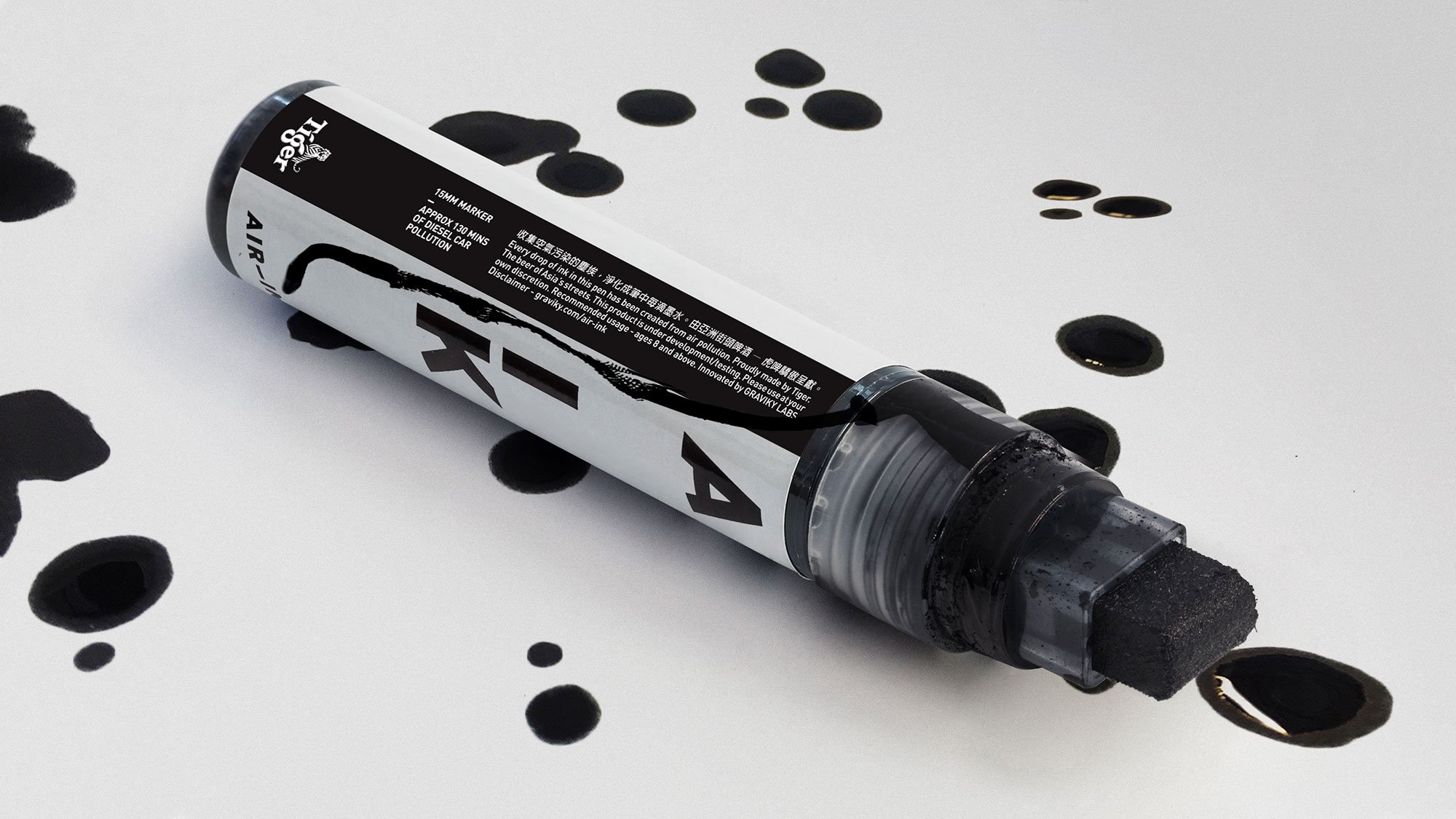
Out of thin Air

@gessato

Following my current blogging, sustainability kick this week, I’m featuring a company called Graviky Labs. Based in Bangalore, India, this team of scientists and industrial designers are creating ink out of air pollution particles.

Yes, you read that correctly. Let me say it again: making ink…out of pollution.

How fascinating, right? I’m not a chemist by any means, so I’m not sure how they actually make it work. But let me break it down for the lay people out there. They produced a can that fits over a car exhaust, which then filters the smoke, creating particles of ash, which are then combined with different solvents to make liquid ink. This ink can then be used by anyone – artists have obviously taken an interest, since it’s such a uniquely creative idea.
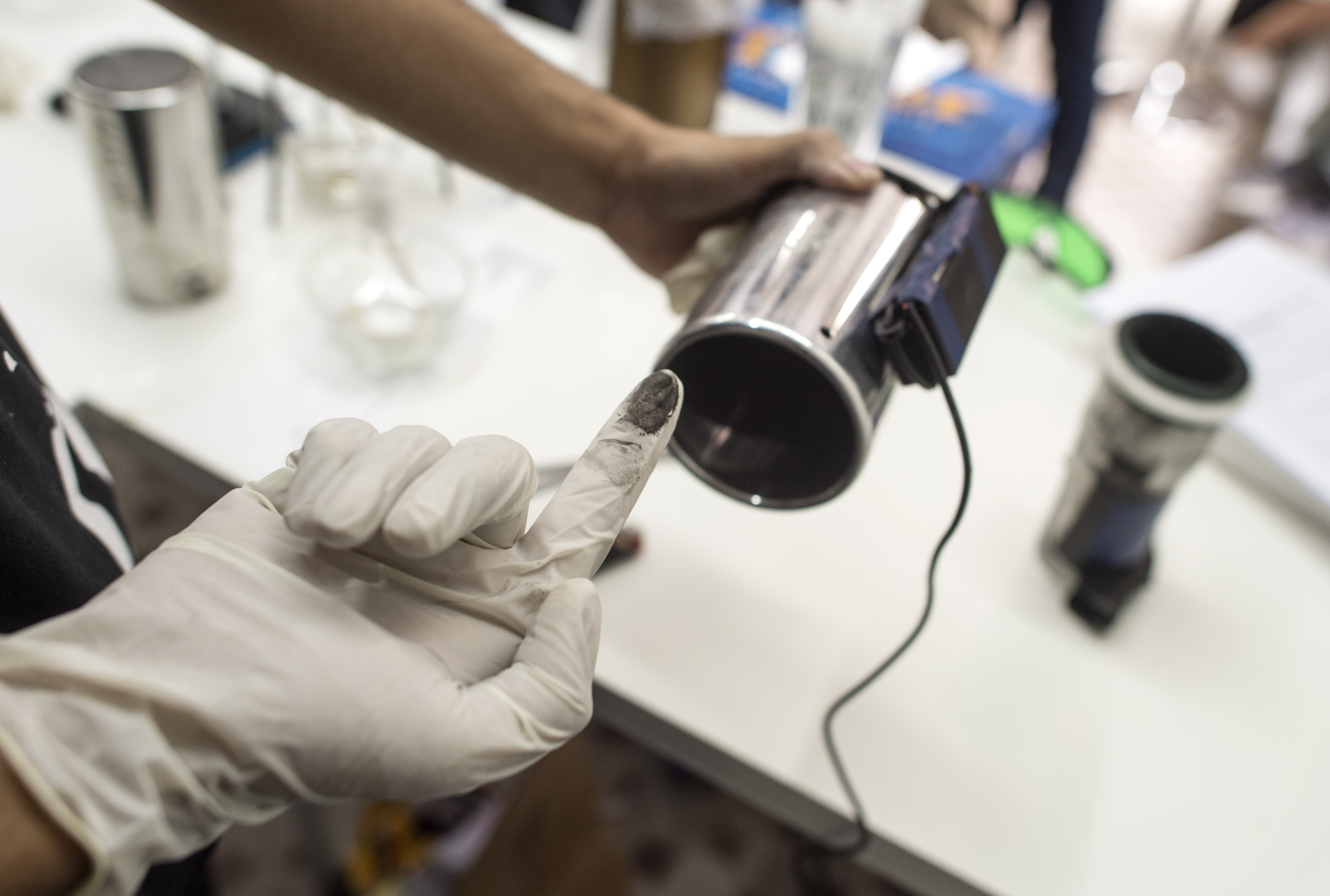
Image result for graviky labs
@cnn

Of all the sectors of pollution, the discussion around air pollution is often dismissed. As physically visible problems – trash in the ocean, dumping of chemicals in undesignated areas, burning of chemicals unlawfully, etc – often trump the unseen, the air we breathe is very nearly forgotten about. But air pollution has been a large contributor to detrimental health problems over the past decade, specifically in Asia.

What really fascinates me is the language they use to describe the pollution, and eventual ink. Their range of markers currently includes a 0.7 mm and 2 mm round tip, a 15 mm chisel tip, and a 50 mm wide tip. Under each marker description they have specifications on the average time it takes to make the ink. For example, a 2mm round tip marker would take approximately 50 minutes of diesel car pollution to create enough particles for the product. How freaking interesting.

Their website clearly states that the main byproduct of fossil fuel burning, is soot. This soot either ends up in water sources or our lungs. They are trying to directly combat the eventual destination by designing a product that takes those particles, and makes something useful and utterly mesmerizing of them. Sure, the ink looks just like any other ink. But when you see someone describe “oh, I illustrated this poster with 100 hours worth of pollution,” it makes the gears in your head turn about a million miles a minute.

Check out the comprehensive video of the patent pending technology below. Enjoy!

Treasured Waste

@gomi.design

Beauty is in the eye of the beholder, right? I’ve previously posted about garbage becoming art, and how transformative the hands of an artist can be. Although there is a special and significant role of fine art in this world, some may argue that art – just for art’s sake – is a form of consumption that cannot necessarily be repurposed. Art pieces are meant to prosper, but what comes of it when the life cycle is over? Unfortunately it becomes trash, just like any other product.

Insert a design company called Gomi. They’re currently still on Kickstarter (check it out here), but they are selling portable speakers made out of 100% recycled plastic. Not only do they look mesmerizing, but they are all handcrafted – every single piece is completely unique. In this day and age, it’s inevitable that we all have clothing, accessories, tech gadgets, and more, that are all mass produced. As someone who despises matching other people, I avidly seek out thrift stores and original-esq pieces that are curated to my lifestyle. So, me, being someone who clearly has individuality issues, this company speaks to me in many ways.

Not only is their philosophy of sustainability fantastically refreshing, the process of their work really speaks to their passion and craft. Exhibit A: they hand collect all of the flexible plastic (plastic bags being one of the worst cases of non-recyclability today) around their city in Brighton, UK; once collected, they melt it down (about 100 bags per speaker) and press it in their molds; each piece is then signed by the artist that creates it, adding, yet again to the uniqueness factor.

I really hope this company succeeds in their fundraising goal. It’d be amazing to see this product shake up the art and design industry!

Packaging as a product

@loop

It seems like everything has been invented. At least most of the things we use on a daily basis. When was the last time we were so blown out of the water by a product that the whole world actually changed? I’m talking, man on the moon, origin of the internet, kind of monumental moments.

Doesn’t seemed to be very progressive as of late. Sure, no one has reinvented the wheel, but we have Squatty Potties. Soooo, the industry seems to be moving in a life-altering direction, right? (That was extremely sarcastic in case anyone thought otherwise)

Anyways. I’ve seen a slow increase of packaging-centric products enter the market within the past year. A beer company in Florida created six-pack rings that can be eaten by marine life. Chiquita now has a sticker that can be used to track where that individual banana came from all over the globe. A wine company created augmented reality (AR) bottle labels that features characters speaking to you:

Now, clearly the fruit and alcohol markets have stepped up their games. But what’s next? We don’t know. However, packaging is increasingly a more integral part of why a product is actually purchased or not. As sustainability becomes more and more important – especially to young consumers – we see companies allocating extra time to their packaging, and not just the contents.

QR codes “died” a few years back, but with the fairly new iOS11 update for Apple products, users can simply snap a picture on their camera and pull up a QR code’s information. Before this update, you’d have to subject yourself to ad-infested apps that essentially took up space on your home screen for only a 2 minute usage every few months. So, with the ease-of-access modernized, these simple yet effective coding mechanisms could revolutionize the new-wave of packaging to come.

I’m not saying edible beer can rings are equivalent to Facebook or the Spork (very revolutionizing, guys). But with things like this, we could be heading into a whole new product sector – taking the packaging and making it its own product. Check out the new Loop startup that just announced its eco-friendly platform for 2019. Packaging no longer has to be purely disposable, wasteful, and obsolete. Now that’s pretty world-changing.

Delivery Robots could be the cutest new tech idea of 2019

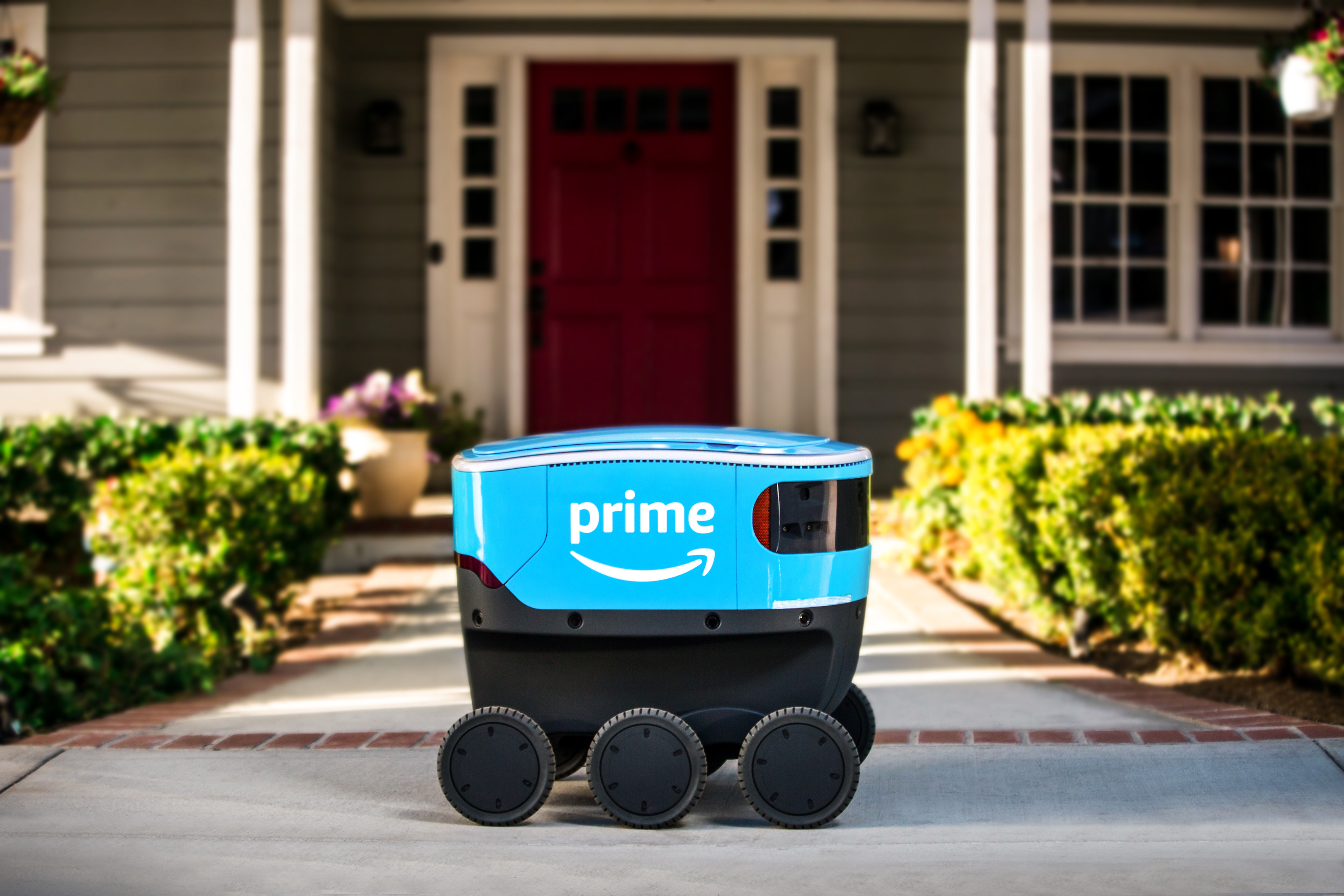
Image result for amazon robot delivery
@amazon

I love Amazon. I’ve used Prime for almost 6 years now, and even after my half-price student discount ends in the near future, I will continue to use it. A teacher of mine who is an avid book worm (he owns thousands of books, and I mean, thousands) told our class he saved almost $5,000 in the first year since getting his Prime account.

The mailing system in our country (and the world for that matter) still amazes me to this day. Yes, certain packages can take weeks to be delivered, and we’ve all had something disappear in the mail at one point or another. But 9 times out of 10, it’s within a few days (in the case of Prime, only 2!) that something – even from across the country – gets to your door.

When you think about how the first few years of the postal service were serviced with horse and buggy, it’s mind-boggling to think of the millions of letters, parcels, packages, and more that are all delivered each day. And not to mention the data the average consumer can get their hands on nowadays. With the Delta app, I get a notification when my suitcase is loaded onto the plane. I know that’s a little different than your average delivery, but with a simple tracking number, I can see one of my packages being delivered tomorrow only has 12 stops until it gets to my apartment building. How is that not crazy incredible?!

I hear people complain about having a shipping confirmation tell them it’ll take 3 days for their order to get to them. 3 DAYS?? C’mon that’s nothing. I understand there are things you can’t wait for, or maybe even need ASAP, but 3 days. The amount of infrastructure, organization of people and places, etc. to get you that fidget spinner you have. to. have. right. this. minute. Give me a break.

So, after this brief gush about one of the modern marvels of the world, let’s insert the latest of the greatest technology (that’s not the saying, but oh well). Amazon is now testing delivery bots. Now, they are completely adorable. And quite honestly I’d love to get a delivery from one of these lil guys; but they do look pretty…dopy. Here’s a short video:

Amazon just started testing these buggers about a month ago. But, Door Dash – a food delivery service from restaurant to home – has been doing research and development of this since early 2017. I honestly haven’t heard much about it, even though this Buzzfeed video had more than 8.7 million views. Guess I’m out of the loop. This short video actually shows the articulation of the three wheels (it’s actually pretty wild!) over curbs, and the camera and sensor systems in place.

Now, my main critique of such a service was actually the possibility of theft. Not necessarily the food (although that would be terribly unfortunate for any hungry person waiting anxiously) but rather the bot itself. One of the Door Dash techs said that they are coming up with ways to deter the thefts however. So the video above kind of debunks my short-lived theory.

I will say, stealing and damaging property were some of the things I thought would ultimately destroy the city scooter phenomenon (back in Portland last year, and now Detroit). But all of the scooter companies seem to be doing great, with most, if not all, of their assets still up and running to this day.

I have to say, I’m kind of excited to see what happens with this. The next revolution of delivery is heating up people! If only Paul Revere could see us now.

The Laws of Art

@bento.box

Well, it’s been a while! Spring break was…interesting. It’s one of those liminal moments in your life at college where everything – and yet nothing – seems to happen. Last year I had traveled to Haiti for a week, and this time, I decided to stay home. I visited my parents, avoided my homework for way too long, met up with friends, slept a lot, and didn’t blog.

I kind of missed it. Believe me, unless you’ve done it consistently before, the chore of it becomes annoying. And yet, when you stop, it’s like something is missing. I haven’t had the chance to think about whether I’ll continue this (even after the assignment is completed). I think only time will tell. Maybe I’ll drop down to posting only a few times a week.

Regardless, part of my spring break time was spent visiting a few art galleries. All of them were featuring student work – some of which go to my own school. Yet again, I was subject to being out of my comfort zone. And that’s always fun.

One thing that really annoys me is when someone will write off a piece of art immediately. And when asked why they didn’t like it, they’ll say “I don’t get it.” Nine times out of ten.

I’m sorry, but what a lame excuse. I’m an art student, have had quite a few classes studying art history and modern design, and yet I *understand* about 1% of the art I see. More often than not, especially when viewing mediums I’m not personally familiar with, I don’t necessarily enjoy the art. But, I’ll be with someone who absolutely adores it.

So where do we draw the line? What is art? I don’t have an answer for you. I don’t think anyone really truly does. One of the worst critiques someone can give or receive at our school is the mere “I like it.” Channel your inner Terrible Twos mantra here: Why?

Ask why over and over again to yourself. If you can’t explain why, keep your “I like/don’t like it” comment to yourself until you’ve figured it out. I’m being harsh here, but it’s an important thing to talk about. Everyone has their own preferences, aesthetics, pet peeves, etc. about art and design. There are observational laws about art (check out this website for a few interesting ones regarding UX design), but there are no rules that tell you what you can and can’t do. And therefore, what classifies it as such.

Dig up some self-awareness and question everything. Art is supposed to be an interaction of viewing and then the thinking of such interaction (and no, that wasn’t me making a law). Even if you hate everything about a piece, find something you think is interesting. Maybe it’s the color placement; the material used; the technique it showcases; the way it’s hung on the wall. I’ve argued with friends about the innate interest of everything. I believe everything is interesting – you just need to look for it. Art is not excluded from this. Look for it, and you’ll find it.

@bento.box

Taking a Break

Image result for social media cleanse
@be.mindly

This week is spring break for me. I have not discerned how long I will be taking a cleanse/pause from technology, but for the next few days, I am making it my goal to avoid the internet and social media.

My hope is that the time I normally spend scrolling online, will be spent reading and exploring other avenues of thought or experience.

I hope the next few days are relaxing for everyone else as well. Au revoir until we meet again! (Aka, Wednesday or Thursday)

The Tattoos of the Future

Related image
@mc10

I’ve always admired, and wanted tattoos. Unfortunately, I find myself to be too spontaneous for such a permanent decision. Being in the art and design world too, my tastes and aesthetics end up changing very frequently. Especially when it comes to typography (which would inevitably be my first type of inking) my favorite font from last month, is now repulsive to me. So, I’ve deliberated for years on tattoos, but can’t seem to figure out what I want to do.

Insert the temporary options. I’ve drawn on myself with pens, sharpie, paint, henna, etc. (much to the chagrin of my father), and it always fills the flippant temptation for an actual tattoo.

MC10, a tech and medical research mogul, created flexible circuit “tattoos” that aid in bio level readings. Though they aren’t main stream yet (they’ve partnered with a couple of companies and schools since the original drop in 2015) I have a feeling this sort of application will be extremely useful (and inevitably fashionable) in the future.

Wearables – especially watches – were the majority of “hit products” at CES this year. But these flexible, tattoo-like patches completely blow those gadgets out of the water (in my humble opinion). I’m not looking to slap these patches everywhere on my body to replace a normal tattoo, especially since these are primarily medical at this point in time, but tech like this is really intriguing for a few reasons.

If these patches had the capability to monitor bodily functions (heart rate amongst the more obvious reasons) and then send that info/data to a user’s app, it would be pretty cool. In a day and age where data collection is becoming more and more popular (and accessible) for the average person, the seamlessness of this technology would be incredible.

There’s been luminescent, projection mapping, and audio-file tattoos. But imagine being able to ink yourself, and have it serve an actual function.

when being the same is popular, do something different

Related image
@android.police

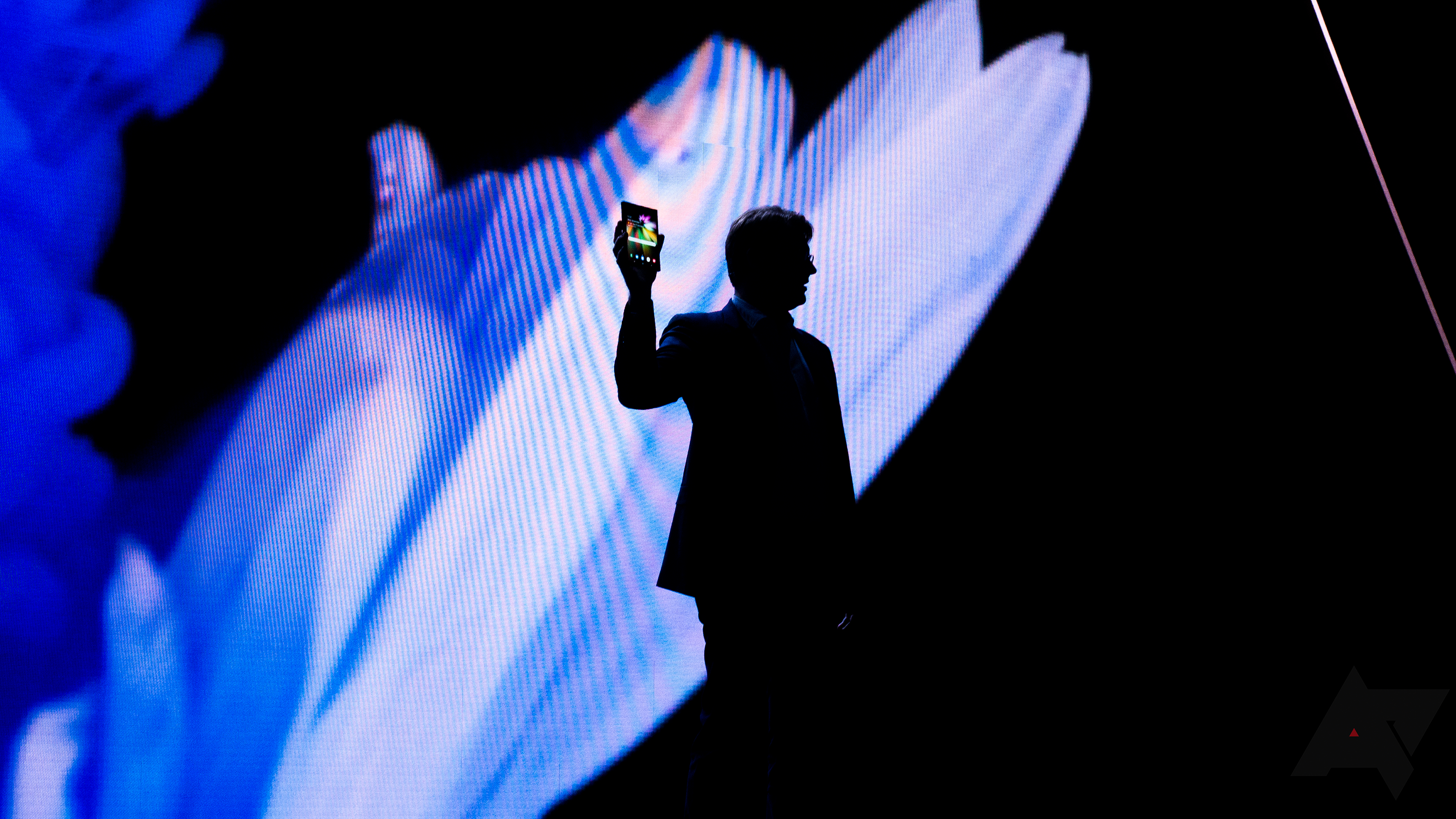
Samsung is one of the biggest tech companies in the world right now. They have been the benchmark for many products in the past, and they just made history this week, bringing out the first foldable phone ever.

Now, I am an avid Apple supporter – mostly due to the fact that I love how efficient the seamlessness is between my iPhone and Mac. Quite frankly, I’ve never been a brand enthusiast. I’m not very particular when it comes to staying true to a company. I like what I like, and what I purchase reflects this – brands typically don’t have a big influence on that. So my current Apple monopoly isn’t necessarily out of respect for the brand, more so the necessity of work flow.

I currently have an iPhone 6 and a 15″ Macbook from 2014. So I’m clearly not concerned with having the latest and greatest gadgets either. My point is, the product development of Apple hasn’t excited me recently. I had no urge to run out and get the iPhone X, and yet, I have no urge to shop around for other brands. Nothing has caught my attention. Apple tends to stick to the same proportions, aesthetic, and materials. I understand it’s a coherent product lineup, but their over-enthusiasm for the “redesign” of the camera from a horizontal orientation to a vertical one, is ridiculous. They could add 1 GB of storage and say it’s a whole new phone with “revolutionary capabilities” and people would eat it up.

I’m being cynical, but as someone who has been directly influenced by the evolution of phones (I had the Motorola Razr and the LG Envy in middle school) it seems ridiculous that nothing has been extremely progressive in the past few years.

Insert Samsung and their most recent Galaxy release. We don’t know the exact name of the phone yet (rumors have dubbed it the X, F, or Fold), but the technology itself seems revolutionary. There’s a slew of problems that will become extremely apparent after consumers get ahold of it, but design isn’t necessarily supposed to have all of the answers in the beginning.

Related image
@cnet

Innovation starts out with an idea. I had an Apple Shuffle iPod a few years after it came out. It didn’t have a screen, you had no idea what song was coming next, and you had no chance to choose. But, the idea behind it – the most compact music device of the time – was the priority.

I’m trying not to be overly critical about Samsung’s ability to change the phone game – that has been completely stagnant for at least the past 6 years – and frankly, I’m more excited about the prospect that big companies are willing to risk not only their reputation and profitability, but design capabilities, on a new concept.

Social practice in the age of loneliness

Image result for communal gardening
@bizcommunity

I went to a lecture tonight after class, and heard Ezio Manzini speak. Now, I’m not gonna proclaim some hipster acuity here because 1) I had no idea who this man was before hearing his talk and 2) my friend was the one who told me I should go in the first place (hi Sam). But man, did he have some interesting things to say. I mean, he does have a few famous books out, so he is obviously an intelligent guy. And I’m clearly the one that lives under a rock (funny I say this, given the topic of discussion).

Anyways, his whole discussion was on the importance of social practice today (and in the future), and how we – especially art and design students – should be active participants in the thought development (and action) of this changing phenomena.

Manzini went into detail about how loneliness has become a disease within our society. Though hyperconnected to the world, our individuality is diminished by our inability to deal with this personal isolation. Technology, especially when it comes to world news and politics, has encouraged us to be knowledgeable about every aspect of the planet – yet rendering us almost defenseless when it comes to our own surroundings (and mind!). This manifests an unmotivated fear within us. And there is a direct link, he claims, between this loneliness and fear.

He says that the best way to counteract these emotions is through social, collaborative activities with others. Organizations that are inherently social have become extremely popular amongst young people recently. It’s interesting and extremely coincidental that he brought up this point, because in my class today we discussed the relationship between the decrease in church-going to the increase of communal groups/practices.

The trend forecaster Jose, that was a guest lecturer in my class, had discussed the increase in Crossfit attendance as a signifier for the rise in non-religious social groups. Manzini gave several examples for these communal groups: shared living spaces, collaborative work areas, training practices (fitness or work related), community agriculture and gardening, shared care/welfare, travel, etc.

All of the groups he was discussing, was placing the importance on the physical interaction of people. In the age of instant online association, we need to change the way we connect with people. Manzini stressed the importance of how social we are as human beings. He even likened our society to an ecosystem. Desertification – like the isolation of people I mentioned previously – leads to fragility of the system overall. The more disconnected people are, the more delicate our relationships. This isn’t rocket science, but what Manzini suggests – the regeneration of this societal ecosystem – is brilliant.

Each person has their own bubble. Whether that is externally forced or personally voluntary, we each have our view of the world. We each have a specific relationship with our immediate surroundings. I liken this to our own little bubbles (as much as “living in a bubble” has a negative connotation these days). But I prefer to visualize this specific adage more than anything.

Manzini said at one point during his lecture, that

Modernity is the melting of ideas.

Now, this seems to air on the side of reductional and destructive. But, to me, melting means melding. The slight difference in those words is key here. I visualize the forging of bubbles – a sort of venndiagram overlapping of spheres. And it seemed optimistic to me – this forging of people, within shared space.

He said several times he has a more pessimistic view of the world – and I can definitely relate to that. But his talk was full of inspiration and ideas for me. I am going to make a point to order his book, Politics of the Everyday (Designing in Dark Times), as soon as possible. And I’ll make sure I seek out these social practices he speaks so highly of. A night well spent, for sure.

The Difference of Human Touch, in a world of tech

Image result for auto companies that got rid of clay sculptors
@detroit.free.press

When I interned at an automotive company this past year, I came in contact with a lot of interesting and talented people. A few of my absolute favorites, were the clay modelers in our design studio. They have the most fascinating way to look at the world. Their ability to transform this mundane substance into beautiful sculpture, is something I’m extremely jealous of.

I’ve always loved automotive clay modeling – it’s this strange medium between fine arts and technical design – and find that it’s highly underrated. Piotr (Peter) was one of the lead sculptors at my job, and ended up becoming a good friend of mine over my 6 months there. Outside of the office one night, I struck up a conversation about how he got into his work. He said he had always admired the beauty and precision of it all, and pursued it right away at school.

He was extremely talented – working for Bugatti, Ferrari, BMW, and countless other top tier auto companies over a +20 year span – and was full of knowledge. Usually a pretty quiet guy, it took me aback when he became very impassioned when discussing clay modeling’s future. He told me that BMW, years ago, fired all of their sculptors (including him), and replaced them all with computers. I asked him what the exact year was (he couldn’t quite place it) but it was somewhere around 5 years ago.

I remember connecting these faint dots in my head later that week. I haven’t liked BMW’s designs within the past few years. I could never place my finger on why though. It seemed to escape me; but something had changed. It lost something special. And now it made sense. I’m not saying I was some genius, making this connection. But it floored me.

Piotr told me they got rid of the human touch – they got rid of the clay sculptors who essentially, put the magic into the design. I was astonished no one was talking about this. I heard another car company overseas – who had switched to full digital methods years ago – had announced their return to clay. I think of all of the cars that have come out recently, and Volvo’s designs have exponentially improved in form within the past year or two. Turns out (I lost the article snippet I had read) that their design team had significantly increased the amount of clay sculptors within their studio. This wasn’t a coincidence just within a few studios.

@digital.trends

Ducati designers were just featured in an article highlighting the process of their newest design (pictured above). And this quote stood out to me:

Tech doesn’t enter the equation until the designers are fully satisfied with what they’ve drawn and [are] ready to move on.

Andrea Ferraresi

It excites me that companies are starting to see this trend. Technology – though improving major sectors of the world – hasn’t completely changed the automotive design process. And I’m extremely happy about that.